
Spinoza: Life and Legacy
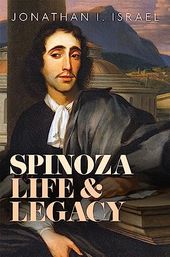
With Spinoza: Life and Legacy, Jonathan Israel has written a biography of arguably the boldest and most unsettling of the early modern philosophers, which examines the man’s life, relationships, writings, and career, while also forcing us to rethink how we previously understood Spinoza’s reception in his own time and in the years following his death. Tonight, Israel will discuss his new book with Tinneke Beeckman and Lukas Verburgt.
There have been surprisingly few biographies of Spinoza, given his fundamental importance in intellectual history and the history of philosophy, Bible criticism, and political thought. In Spinoza: Life and Legacy, Jonathan Israel has woven the circumstances of Spinoza’s life and thought into a detailed biography. This has led to several notable instances of nuancing or revising our notions of how to interpret certain of Spinoza’s assertions and philosophical claims, and how to understand the complex international reaction to his work during his life-time and in the years immediately following his death.
Contrary to what has sometimes been maintained, Israel argues that Spinoza’s general impact was immediate, very widespread, and profound. One of the main objectives of his book is to show how early and how deeply Leibniz, Bayle, Arnauld, Henry More, Anne Conway, Richard Baxter, Robert Boyle, Henry Oldenburg, Pierre-Daniel Huet, Richard Simon, and Nicholas Steno, among many others, were affected by and led to wrestle with Spinoza’s principal ideas.
About the speakers
Jonathan Israel was born and educated in London, graduated at Cambridge, and gained his PhD at Oxford under the supervision of Hugh Trevor-Roper. He taught for thirty years in British universities before being appointed Professor of Modern History at the Institute for Advanced Study, Princeton. He retired in 2016.
Tinneke Beeckman is a Belgian philosopher, lecturer and columnist for Knack and De Standaard. Amongst her publications are Door Spinoza’s lens (2012), Macht en onmacht (2015) and Machiavelli’s lef (2015) which was awarded with the Hypatia Prize and shortlisted for the Socratesbeker.
Pooyan Tamimi Arab (moderator) is an assistant professor at the Department of Philosophy and Religious Studies of the University of Utrecht. His research combines social scientific approaches to religious studies with political philosophy.
:rgb(-15,-3,-18)/https://admin.spui25.nl/wp-content/uploads/2026/01/pawel-czerwinski-dQriq2v8xxc-unsplash.jpg)

:rgb(-25,-2,1)/https://admin.spui25.nl/wp-content/uploads/2026/01/Hans-Peters-Demonstratie-tegen-de-Amerikaanse-heksenjacht-op-homosexuelen.-1977.-ANEFO.NA-04894.jpg)

:rgb(8,-11,-35)/https://admin.spui25.nl/wp-content/uploads/2026/01/francesco-gallarotti-ruQHpukrN7c-unsplash.jpg)
