
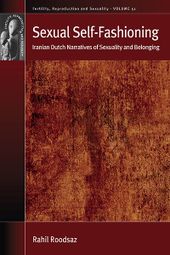
Sexual Self-Fashioning: Iranian Dutch Narratives of Sexuality and Belonging
Anthropologist Rahil Roodsaz investigates Iranian Dutch narratives of sexuality and belonging in her book Sexual Self-Fashioning: Iranian Dutch Narratives of Sexuality and Belonging. During this programme Roodsaz will present her new book, addressing the ways in which sexuality and gender have come to serve as measures for cultural belonging in discussions of the position of Muslim immigrants in multicultural Western societies. Roodsaz’ lecture marks the opening of the Amsterdam Research Centre for Gender & Sexuality’s new academic year.
While the acceptance of assumed local norms such as sexual liberty and gender equality are seen as successful integration, rejecting them is regarded as a sign of failed citizenship. Focusing on premarital sex, homosexuality, and cohabitation outside marriage, Sexual Self-Fashioning: Iranian Dutch Narratives of Sexuality and Belonging provides an ethnographic account of sexuality among the Iranian Dutch. It argues that by embracing, rejecting, and questioning modernity in stories about sexuality, the Iranian Dutch actively engage in processes of self-fashioning.
About the speakers
Rahil Roodsaz is an assistant professor of anthropology at the University of Amsterdam. She obtained her PhD in 2015 on sexual self-fashioning among the Iranian Dutch at the Institute for Gender Studies of the Radboud University Nijmegen. Her current research and teaching revolve around the political potential of love from feminist, queer, and decolonial perspectives.
Wigbertson Julian Isena (he/they) is an Assistant Professor in Anthropology at the University of Amsterdam. His research centers on gender, sexuality, and postcolonial contexts, particularly in the Dutch Caribbean, analyzing the intersection of gender rights, tourism, and neo-colonial relations with the Netherlands. His works have been published in journals and publications like “Tijdschrift voor Genderstudies,” “Feminist Review,” “Routledge Companion to Sexuality and Colonialism,” and his monograph titled The Question of Dutch Politics as a Matter of Theater appeared in 2017.
Julie McBrien is Associate Professor of Anthropology and director of the Amsterdam Research Center for Gender and Sexuality. Her current research investigates questions of nationalism, international development and the politics of the future by interrogating late-Soviet and post-Soviet era interventions into martial practices in Central Asia. She is author of From Belonging to Belief: Modern Secularisms and the Construction of Religion in Kyrgyzstan (The University of Pittsburgh Press, 2017) and editor of Muslim Marriage and Non-Marriage: Where Religion and Politics Meet Intimate Life (Leuven University Press, In press).
:rgb(-15,-3,-18)/https://admin.spui25.nl/wp-content/uploads/2026/01/pawel-czerwinski-dQriq2v8xxc-unsplash.jpg)

:rgb(-25,-2,1)/https://admin.spui25.nl/wp-content/uploads/2026/01/Hans-Peters-Demonstratie-tegen-de-Amerikaanse-heksenjacht-op-homosexuelen.-1977.-ANEFO.NA-04894.jpg)

:rgb(8,-11,-35)/https://admin.spui25.nl/wp-content/uploads/2026/01/francesco-gallarotti-ruQHpukrN7c-unsplash.jpg)
