
Preparing for War
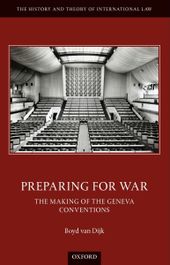
The Geneva Conventions have hit the headlines since Putin’s invasion into Ukraine. These treaties, which represent the most important rules for armed conflict ever formulated, lay down an extensive list of protections for victims of war. But their history is often misunderstood. This roundtable, based on a new book by Boyd van Dijk, discusses the historical, legal, and political dimensions of international law in wartime.
For many observers, the drafters behind the Geneva Conventions of 1949 were primarily motivated by liberal humanitarian principles and the shock of the atrocities of the Second World War. Boyd van Dijk’s new book, Preparing for War, tells a different story. It argues that a better way to understand the politics and ideas of the Conventions’ drafters is to see them less as passive characters responding to past events than as active protagonists trying to shape the future of warfare. In many different ways, they tried to define the contours of future battlefields—including the one in Ukraine today—by deciding who deserved protection and what counted as a legitimate target.
Outlawing illegal conduct in wartime did as much to outline the silhouette of humanized war as to establish the legality of waging war itself. Although they did not seek war as such, drafters prepared for it by means of weaving a new legal safety net in the event that their worst fear should materialize, a specter still haunting us today.
About the speakers
Boyd van Dijk is a McKenzie Fellow at the University of Melbourne. He was a visiting fellow in Wolfson College and the Lauterpacht Centre for International Law at the University of Cambridge. He is an historian of modern Europe and the international (legal) order. He is the author of Preparing for War: The Making of the Geneva Conventions (Oxford University Press 2022).
Janne Nijman is a professor in the history and theory of international law at the Amsterdam Law School of the University of Amsterdam. She is the chairperson of the executive board and academic director of the T.M.C. Asser Institute, in The Hague. She is also a professor of international law at the Graduate Institute in Geneva. Her research interests concern the history and theory of international law, empire, and human rights.
Claire Vergerio is an assistant professor of international relations at the University of Leiden. She is specialized in the study of history, political thought, and international law – including the regulation of warfare. Her forthcoming book, entitled War, States, and International Order: Alberico Gentili and the Foundational Myth of the Laws of War, is forthcoming with Cambridge University Press.
Tamar de Waal (moderator) is an assistant professor in legal theory at the Amsterdam Law School of the University of Amsterdam. She is the author of Integration Requirements for Immigrants in Europe: A Legal-Philosophical Inquiry (Hart 2021). She is also the director of the Amsterdam Honors College of Law. Her research specializations involve questions of citizenship and interdisciplinary legal research methods.
:rgb(-15,-3,-18)/https://admin.spui25.nl/wp-content/uploads/2026/01/pawel-czerwinski-dQriq2v8xxc-unsplash.jpg)

:rgb(-25,-2,1)/https://admin.spui25.nl/wp-content/uploads/2025/10/nedret-binici-j3ZnRpYrxHs-unsplash.jpg)

:rgb(8,-11,-35)/https://admin.spui25.nl/wp-content/uploads/2025/07/daniele-levis-pelusi-LyiuOfvh_8Y-unsplash.jpg)
