
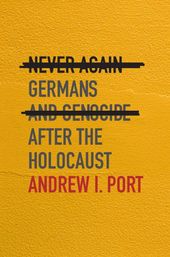
Never Again: Germans and Genocide after the Holocaust
Germans remember the Nazi past so that it may never happen again. But how has the abstract vow to remember been translated into concrete action to prevent new genocides abroad? In this lecture, historian Andrew Port will examine this question in relation to the genocides that took place in Cambodia, Bosnia, and Rwanda.
When it comes to German efforts to confront the Nazi past, conventional approaches tend to focus on solemn statements and well-meant monuments. In his book Never Again: Germans and Genocide after the Holocaust (Belknap/Harvard, 2023), Andrew Port, Professor of History at Wayne State University, looks instead at the very concrete ways in which postwar Germans embraced the lessons of the Third Reich and the Holocaust—above all in response to other genocides that took place elsewhere after 1945 in places like Cambodia, Bosnia, and Rwanda. This innovative approach makes the lessons, limits, and liabilities of politics driven by memories of a troubled history harrowingly clear.
About the speakers
Andrew I. Port is professor of history at Wayne State University in Detroit. He is the author of ‘Never Again: Germans and Genocide after the Holocaust’, ‘Conflict and Stability in the German Democratic Republic’, and ‘Becoming East German: Structures and Sensibilities after Hitler’. Port received degrees in history from Yale and Harvard, and is the recipient of the DAAD Prize for Distinguished Scholarship in German and European Studies. He is also the former editor-in-chief of the flagship journal Central European History.
Mario Daniels (moderator) is the DAAD-Fachlektor of the Duitsland Instituut Amsterdam. He holds a PhD from the University of Tübingen, taught at the Universities of Tübingen and Hannover, and was twice a research fellow at the German Historical Institute in Washington, D.C. From 2015 to 2020 he was the DAAD Visiting Professor at the BMW Center for German and European Studies at Georgetown University. His latest book, co-authored with John Krige, Knowledge Regulation and National Security in Postwar America, was published with University of Chicago Press in April 2022.
:rgb(-15,-3,-18)/https://admin.spui25.nl/wp-content/uploads/2026/01/pawel-czerwinski-dQriq2v8xxc-unsplash.jpg)

:rgb(-25,-2,1)/https://admin.spui25.nl/wp-content/uploads/2025/10/nedret-binici-j3ZnRpYrxHs-unsplash.jpg)

:rgb(8,-11,-35)/https://admin.spui25.nl/wp-content/uploads/2025/07/daniele-levis-pelusi-LyiuOfvh_8Y-unsplash.jpg)
