
Living in a Vortex: On Writing World History at a Time of Globalisation Blues
The glory days of globalisation are over. After the sobering experiences of the last few years, little remains of the faith that growing international exchange will foster mutual understanding and cooperation. At the same, the environmental crisis makes it ever more important to think on a global scale. Pollution knows no borders, and the same holds true for erosion, loss of biodiversity, climate change and other issues at the interface of man and the natural world. The predicament of our times urges a new type of world history. In his Amsterdam German Studies Lecture, Frank Uekötter offers a novel approach.
According to historian Frank Uekötter, today’s world history writing should allow us to chart the trajectory of humans and their environments in the age of global modernity: what if we view ourselves as captives of a giant, planet-sized vortex with plenty of turbulence, cross-currents, and efforts to regulate or manipulate the flow of water? The vortex evokes a sense of being pushed around by faceless material forces, reflecting the insights of earth system science and the case for a new geological epoch, the anthropocene. At the same time, there is plenty of human agency inside a vortex, as humans seek to work with the flow or simply stay above water. But most of all, the concept provides a powerful reminder that we need a new mode of historical narration. Linear narratives with clear starts, endings, and moral bottom lines fare poorly in the rough waters of the vortex.
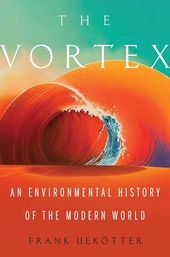
Today’s lecture is based on Uekötter’s monograph The Vortex: An Environmental History of the Modern World, recently published by the University of Pittsburgh Press. Drawing on examples as diverse as sugar, guano, battery chicken, and DDT, it traces the making of an entangled multidimensional legacy that continues to shape global environmental thinking and action in the new millennium. Living in the vortex is about making choices–and maybe we can make more sustainable choices if we view our current predicament from a new angle.
About the speaker
Frank Uekötter is Professor of Environmental Humanities at Birmingham University, working on environmental issues, both past and present, in a global context.
:rgb(-15,-3,-18)/https://admin.spui25.nl/wp-content/uploads/2026/01/pawel-czerwinski-dQriq2v8xxc-unsplash.jpg)

:rgb(-25,-2,1)/https://admin.spui25.nl/wp-content/uploads/2025/10/nedret-binici-j3ZnRpYrxHs-unsplash.jpg)

:rgb(8,-11,-35)/https://admin.spui25.nl/wp-content/uploads/2025/07/daniele-levis-pelusi-LyiuOfvh_8Y-unsplash.jpg)
