
Welfare Chauvinism in Europe
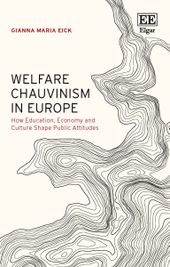
Should migrants in Europe receive social benefits and services? Not according to the notion of welfare chauvinism, which is currently at the heart of political conflicts in many societies. With the launch of her new book Welfare Chauvinism in Europe, Gianna Maria Eick will discuss this concept, unveiling how the public in Europe really thinks about it.
The redistribution of welfare resources to migrants continues to polarise society, also in the Netherlands. Not only politicians from the radical right but also from more mainstream parties are capitalising on the idea of ‘welfare for our kind’, or welfare chauvinism.
By creating an extensive overview of welfare chauvinism’s causes and consequences, Welfare Chauvinism in Europe sheds light on the multidimensionality of the opposition towards welfare for migrants across countries, time, social policies, and migrant groups. Hereby, Gianna Maria Eick exposes hidden nuances regarding welfare chauvinism that are frequently overlooked in current discourse, particularly concerning socioeconomic cleavages in Europe. Using high-quality data on public attitudes and macro-level conditions, her new book also investigates the common misperception that higher levels of education universally lead to more tolerant attitudes and she argues that governments and welfare institutions play a crucial role in shaping public opinion.
During this book launch Eick will present the main findings of her book and several leading scholars in the field of migration and welfare will offer their views on different parts of the book. Later we will open the discussion to the audience and invite everyone to drinks and snacks.
About the speakers
Gianna Maria Eick is an Assistant Professor in Political Science at the University of Amsterdam and she is a member of the Amsterdam Research Centre for Migration. Eick specializes in social rights, the development of new social policies, migration, Euroscepticism, and the increasing inequality in the wake of recent crises. She has received prestigious international research grants and prizes for her academic work, and is currently part of several (cross-national) research projects, including the Horizon 2020 project “The Future of European Social Citizenship”.
Hein de Haas is a Professor of Sociology at the University of Amsterdam and an Extraordinary Professor of Migration and Development at the University of Maastricht. He is a member of the Amsterdam Research Centre for Migration. De Haas does research on long-term migration trends as well as causes and impacts of international migration in origin and destination societies. He is the lead author of The Age of Migration: International Population Movements in the Modern World, and recently published his new book How Migration Really Works: A Factful Guide to the Most Divisive Issue in Politics.
Benjamin Leruth is an Assistant Professor in Politics and Society at the University of Groningen. He specializes in comparative welfare policy, long-term politics, democratic innovations, Euroscepticism, and differentiation in the European Union. Leruth is the co-author and co-editor of various books, such as After Austerity (Oxford University Press, 2017), two Routledge Handbooks (on Euroscepticism, 2018, and on Differentiation in the European Union, 2022), and Attitudes, Aspirations and Welfare (Palgrave, 2018). He is also the Editor-in-Chief of Acta Politica.
Femke Roosma is a Professor by special appointment in the Dr J.M. den Uyl chair at the University of Amsterdam’s Faculty of Social and Behavioural Sciences and Assistant Professor in Sociology at the University of Tilburg. Roosma specializes in welfare state legitimacy, the deservingness of beneficiaries and Universal Basic Income. She is co-author of A Research Agenda for Public Attitudes to Welfare and co-editor of The Social Legitimacy of Targeted Welfare: Attitudes to Welfare Deservingness (Edward Elgar Publishing, 2023 and 2017).
Simone Peek (moderator)
:rgb(-15,-3,-18)/https://admin.spui25.nl/wp-content/uploads/2026/02/nahrizul-kadri-OAsF0QMRWlA-unsplash.jpg)

:rgb(-25,-2,1)/https://admin.spui25.nl/wp-content/uploads/2025/10/Omslagafbeelding-voor-de-webpagina.png)

:rgb(8,-11,-35)/https://admin.spui25.nl/wp-content/uploads/2025/10/Illustration-Cost-of-War.jpg)
