
The Quest for Individual Freedom
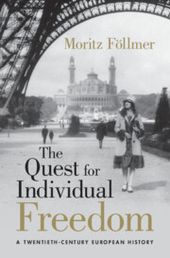
In his new book, Moritz Föllmer studies the yearning for freedom as experienced by ordinary Europeans in the twentieth century. It is published in a world in which freedom is once again at stake. Looking back at past experiences of and debates on freedom enables us to put current developments in perspective. This afternoon, Hanco Jürgens will discuss the book with the author and historians Willemijn Ruberg and Josephine Hoegaerts.
Freedom has many meanings. It is mostly studied as an idea that was defended against totalitarian powers. As such, Europe is considered part of the ‘Free World’. For others, freedom is in decline since it is defended by those who already enjoy wealth and power at the expense of the less fortunate. In his new book, Moritz Föllmer highlights the tension between ordinary people’s efforts to secure personal independence and the ambitious attempts of thinkers and activists to embed notions of freedom in their political and cultural agendas. He shows that, in the twentieth century, freedom had many meanings and was understood in various ways. Men and women articulated and pursued it against the backdrop of two world wars, the expanding power of the state, the constraints of working life, pre-established moral norms, the growing influence of America, and uncertain futures of colonial rule. But although claims to individual freedom could be steered and stymied, they could not, ultimately, be suppressed.
About the speakers
Moritz Föllmer is Associate Professor of Modern History at the University of Amsterdam, having previously taught at the University of Leeds and the Humboldt University Berlin. Among his many publications on twentieth-century German history are Individuality in Berlin: Self and Society from Weimar to the Wall (Cambridge UP, 2013) and Culture in the Third Reich (Oxford UP, 2020).
Josephine Hoegaerts is Professor of European Culture after 1800 at the University of Amsterdam’s European Studies group, where she explores the histories of speech and sound in modern democracies. Her research investigates topics from citizenship and political participation to the embodiment of authority in nineteenth-century Europe.
Willemijn Ruberg is associate professor of cultural history and head of the Cultural History group at Utrecht University. Her research interests include the modern history of gender, sexuality, emotions, law, knowledge, forensic expertise and the body, as well as cultural theory. Among other publications, she published History of the Body (Palgrave MacMillan 2020). Currently she is working on a book discussing the cultural history of the right to bodily integrity in modern Europe. Also, she is co-editor of the Oxford Handbook of the History of the Modern Body (2027).
Hanco Jürgens (moderator) is a member of the academic staff at the Duitsland Instituut Amsterdam. He specializes in German and modern European history. He published on a variety of topics, such as the history of Dutch German relations, German EU-policy, the Third Way, and German missionaries in India in the Eighteenth Century. Currently, he focuses on the history of Germany since the fall of the Wall.
:rgb(-15,-3,-18)/https://admin.spui25.nl/wp-content/uploads/2026/02/nahrizul-kadri-OAsF0QMRWlA-unsplash.jpg)

:rgb(-25,-2,1)/https://admin.spui25.nl/wp-content/uploads/2026/03/Gospodinov-Georgi-_©Phelia_Baruh.jpg)

:rgb(8,-11,-35)/https://admin.spui25.nl/wp-content/uploads/2026/03/Europa.png)
