
Staying Healthy in a Medieval City
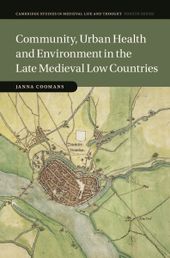
How was public health organised in premodern societies, and does our knowledge about the more distant past relate to experience of pandemic and public health and environmental challenges today? Various historians explore these and other questions following the publication of Community Urban Health and Environment in the Late Medieval Low Countries, in which Janna Coomans debunks the myth of medieval cities as apathetic towards filth and disease.
At the entrance you are requested to show your coronavirus pass.
This event can also be attended online.
Based on new archival research and adopting a political land spatial-material approach, Coomans traces in her book how cities developed a broad range of practices to protect themselves and fight disease. Urban societies negotiated challenges to their collective health in the face of social, political and environmental change, transforming ideas on civic duties and the common good. Tasks were divided among different groups, including town governments, neighbours and guilds, and affected a wide range of areas, from water, fire and food, to pigs, prostitutes and plague. By studying these efforts in the round, Coomans offers new comparative insights and bolsters our understanding of the importance of population health and the physical world – infrastructures, flora and fauna – in governing medieval cities.
About the speakers
Guy Geltner is Professor of Medieval History at Monash University. He is a social and cultural historian of mining, public health, punishment and cities, often drawing on documents from Italian archives in the period 1200-1500. His recent book on the topic is Roads to health (UPenn, 2020)
Claire Weeda is Lecturer at the institute for History at Leiden University. She is a cultural historian whose main fields of interest include ethnic stereotyping, the history of the body, Greco-Arabic medicine, and organic politics in Europe, 1100-1500. Her dissertation was published recently as Ethnicity in Medieval Europe, 950-1250: Medicine, Power and Religion (Boydell & Brewer, 2021). Her current research focuses on the development and spread of medical knowledge in urban centres from 1100-1500.
Janna Coomans is a postdoctoral researcher in the ERC project ‘Healthscaping Urban Europe’. She obtained her PhD on public health in the medieval Low Countries cum laude, which received the Praemium Erasmianum and Pro Civitate prizes. Her main research interests are the history of cities, health and environments, as well as gender, crime and daily politics. She started her VENI project, titled ‘(In)flammable Cities: How fire risks and prevention transformed the Low Countries (1200-1650)’ at Utrecht University in September 2021.
Manon S. Parry (moderator) is an historian of medicine and exhibition curator, specializing in the uses of the humanities for health and wellbeing. She is currently Professor of Medical History at the Vrije Universiteit, Amsterdam, and Senior Lecturer in American Studies and Public History at the University of Amsterdam. She has served in formal and informal advisory roles for exhibition projects on health and medicine in museums in both Europe and the US.
:rgb(-15,-3,-18)/https://admin.spui25.nl/wp-content/uploads/2026/01/pawel-czerwinski-dQriq2v8xxc-unsplash.jpg)

:rgb(-25,-2,1)/https://admin.spui25.nl/wp-content/uploads/2025/07/climate-change.jpg)

:rgb(8,-11,-35)/https://admin.spui25.nl/wp-content/uploads/2025/09/annie-spratt-71amh7N_FgE-unsplash.jpg)
