
Niki means Victory – but over what?
On the occasion of the Dutch translation in 2023 of the novel Niki (2014) by the Greek writer Christos Chomenidis – longlisted for the (Dutch) European Literature Prize – the author will have a conversation with Michel Krielaars and Elke Weesjes about the myths and realities around ideological forms of education in Greece, the Netherlands, and former communist states, and the multiple afterlives of history in the present.
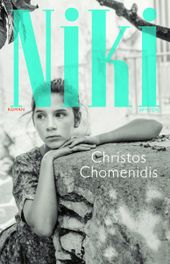
In the novel Niki (2014) by the Greek writer Christos Chomenidis, published in Dutch translation by Hero Hokwerda in 2023, the life of Niki (the author’s mother) unfolds under the prism of her gradual emancipation from the shackles of a rigid communist upbringing. Her story, from her birth in 1937 to 1957, when she leaves her parents and chooses for the man she loves, takes shape against the backdrop of the turbulent Greek history of those years.
On the occasion of the Dutch translation of Niki, we will have a panel discussion between the author and two speakers, Michel Krielaars and Elke Weesjes, who will respond to the novel through their own work and experience, and draw transnational connections with other contexts. We will talk about the myths and realities around ideological and dogmatic forms of education in Greece, the Netherlands, and former communist states. Which forms of thought and action can such education generate, and how do they resonate in the present, 25 years after the fall of Eastern-bloc communism?
The discussion will not be limited to communist upbringing, but can extend to other forms of ideological or dogmatic education (e.g. religious). What are the effects of such an upbringing for children? What parallels can we trace between Niki’s upbringing and other forms of ideological education? And how does literature mediate the relation between personal stories and history, or between the family and the nation, in historical periods fraught with conflicts and political polarization?
About the speakers
Christos Chomenidis was born in 1966 in Athens where he studied Law. In 1993 he published his first novel, The Wise Child, which launched his career as a professional writer. His subsequent novels and lots of his short stories were translated in various languages (French, English, Lithuanian, Polish, Turkish, Hebrew). Chomenidis has also written scripts for cinema and television, and writes a weekly column in the newspaper Ta Nea. In 2021, his novel Niki won the European Book Award (Prix du Livre Europeen).
Elke Weesjes is an adjunct associate professor of history at the City University of New York and specializes in the social history of radical movements in Europe and the United States. She is the author of Growing Up Communist in the Netherlands and Britain: Childhood, Political Activism, and Identity Formation (Amsterdam University Press, 2021), Mama las Marx: communistische gezinnen in naoorlogs Nederland (Mazirel Pers, 2023) and has been an editorial board member of Twentieth Century Communism: A Journal of International History since 2019.
Michel Krielaars is a writer, journalist and editor of the literature section of NRC newspaper. He studied history and Russian at the University of Amsterdam. Krielaars has written various novels, a short-story collection, and books about Russian history. His most recent book is Oorlog met Rusland (2022).
Hero Hokwerda studied Classics and Medieval and Modern Greek Literature in Groningen and Thessaloníki. From 1979-2014 he taught Modern Greek Language and Literature (first in Groningen, from 2002 in Amsterdam) and was a translator of Modern Greek Literature, which he continues to be. He is also editor of the publishing house Ta Grammata (two series Obolos, Greek poetry, and Grieks Proza, with around 60 titles so far.
Maria Boletsi (moderator) is Endowed Professor of Modern Greek Studies at the University of Amsterdam, where she holds the Marilena Laskaridis Chair, and Associate Professor in Literary Studies at Leiden University. She is author of Barbarism and Its Discontents (Stanford UP 2013) and Specters of Cavafy (Michigan UP 2024), and co-author of Barbarian: Explorations of a Western Concept in Theory, Literature and the Arts (Metzler, in 2 vols; 2018/2023).
:rgb(-15,-3,-18)/https://admin.spui25.nl/wp-content/uploads/2026/02/nahrizul-kadri-OAsF0QMRWlA-unsplash.jpg)

:rgb(-25,-2,1)/https://admin.spui25.nl/wp-content/uploads/2026/02/Omslagfoto.jpg)

:rgb(8,-11,-35)/https://admin.spui25.nl/wp-content/uploads/2026/03/pelicot.png)
