
Eaten by the Internet
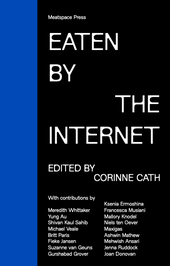
Our world is eaten by the Internet. This means that those who control the Internet control the bounds of public speech, economic production, social cohesion, and politics, making its infrastructure a core political terrain in the networked age. This evening we honor a new book about the power of Big Tech and the future of the digital society, Eaten by the Internet. The discussion with the book’s authors and editor will make Internet infrastructure visible as a key force of political power and urge us to ask how can we ensure the Internet will sustain us, rather than consume us?
To understand power in the contemporary Internet industry, we must look closely at its often invisible infrastructure. This is made of material components such as cell antennas, clouds, chips, data servers, and satellites, but also less tangible, equally crucial standards and software components, including the operating systems, browsers, and computing power that enables connectivity. All these components rarely attract our attention unless something breaks down. And even then, many Internet users won’t ask why.
Eaten by Internet makes Internet infrastructure visible as a force of political power, demonstrating how it is transforming the social world. Four of the original contributors of the book will be present to discuss their chapters, taking on thorny topics, such as power consolidation in the advertisement and cloud industry, online censorship in Asia, the role of Internet infrastructure in governmental and corporate surveillance in the city of Amsterdam, and tech’s environmental impact – amongst others. In doing so, this event will root contemporary technology debates in the politics of digital infrastructure and help us design an Internet that answers to public values.
About the speakers
Corinne Cath is a post-doctoral researcher at the University of Delft funded by the Algosoc consortium, a fellow at the UvA’s critical infrastructure lab, and a research associate at the Minderoo Centre for Technology and Democracy at Cambridge.
Gurshabad Grover is a technologist and legal researcher based in Delhi, India. Gurshabad’s research focuses on network security, censorship, and surveillance.
Fieke Jansen is the co-founder of the critical infrastructure lab and a post-doctoral Researcher at the University of Amsterdam. She also coordinates the Green Screen climate justice and digital rights coalition.
Michael Veale is an Associate Professor in digital rights and regulation at University College London’s Faculty of Laws. His research focuses on understanding and addressing challenges of power and justice that digital technologies and their users create and exacerbate, in areas such as privacy-enhancing technologies and machine learning.
Niels ten Oever is an Assistant Professor of AI and European Democracies at the European Studies Department and co-founder of the critical infrastructure lab at the University of Amsterdam.
:rgb(-15,-3,-18)/https://admin.spui25.nl/wp-content/uploads/2026/02/nahrizul-kadri-OAsF0QMRWlA-unsplash.jpg)

:rgb(-25,-2,1)/https://admin.spui25.nl/wp-content/uploads/2026/02/Omslagfoto.jpg)

:rgb(8,-11,-35)/https://admin.spui25.nl/wp-content/uploads/2026/03/delicate.png)
